kimchi soft scrambled eggs
spicy, soft scrambled eggs for a spicy, soft, scrambling girl
mains
breakfast
COMMUNITY FAVORITE
December 15, 2020
last updated: July 26, 2025


kimchi soft scrambled eggs
Course: Breakfast-16
servings10
minutes2
minutes13
minutesIngredients
1 tbsp butter, divided into ½ tbsps
2 eggs
kimchi, sliced with the “grain” (see recipe notes)
Serve over: white rice, brown rice, soft rolls, crusty buns, or sourdough toast
Optional toppings: kimchi juice, gochugaru, scallions, white or black sesame seeds
Instructions
- Gently whisk eggs, just enough so that the yolks are broken and mixed in with the whites.
- Melt ½ tbsp butter on non-stick pan on medium low.
- Use a small non-stick pan if only making one serving. I use a 8” pan.
- Once butter is melted, add eggs. To check heat, add a little drop to the pan. The egg drop should not sizzle. If it sizzles, take the pan off the heat for 2 minutes, return to the heat, and then test again.
- About 2 minutes later, once the egg starts coagulating and the edges become slightly formed, start pulling the edges towards the middle of the pan. Curds will start to form. At this point, do not step away from the pan and do not turn the heat up.
- As the edges reform, continuously pull the edges towards the middle.
If the pan gets too hot and the curdles are forming too fast, take the pan of the heat. Alternate between pulling the edges and moving the eggs in a circular around the pan using your wrist.
- Once your eggs are set to the consistency of your liking, remove from heat.
I prefer my soft scrambled eggs extremely loose, which is about ~15 minutes of pulling edges/rotating on medium low heat. - Add ½ tbsp butter and sliced kimchi. Mix in pan until just combined.

- Plate over rice or bread. Spoon ~2 tsp kimchi juice over the egg and top with gochugaru flakes, scallions, and sesame seeds. Consume immediately: the eggs will continue to cook on any residual heat. Voila eggs, butter, and fermented cabbage!
Notes
- I use a eye-measured volume ratio of 2 eggs : 1 sliced kimchi, but feel free to measure with your heart.
- Slice kimchi “with the grain,” meaning with knife position parallel to the grain, or ridges.
non-negotiables
- Well-fermented Kimchi — When cooking with kimchi (as opposed to eating it raw), Koreans normally cook with well-fermented kimchi–kimchi from a jar that has been open for a couple weeks. Older kimchi is more pungent, that is more sour and less bitter.
- Kimchi bits — In a jar of kimchi, you’ll find more taut bits and more scraggly bits of the bok choy. Use both in this recipe for variety of texture. I use a 1:1 of taut:scraggly. Cut the taut bits with the “grain” of the cabbage (as opposed to against or perpendicular the “grain”).
try experimenting with
- Consistency — My personal preference is a very jammy soft scrambled since I am very pro-yolk. I can dip whatever vehicle (whether it be bread or rice) into my eggs like a sauce! It takes me around 15 minutes, repeatedly taking the pan on-and-off the heat to get this consistency. If you like your soft scrambled more hard, cook for longer (although I wouldn’t go any longer than 18-20 minutes).
extra ingredients?
- Extra eggs? Make korean drug eggs.
recipe development notes
Test #1
I always thought scrambled eggs were the worst way to consume an egg: you lose all the runny and yolky goodness! But ever since @paris.starn made SOFT scrambled eggs on her stories, I’ve been hooked. Soft scrambled eggs doubles the amount of runny yolk—incorporating the whites into the jamminess. Because curdles form as it’s cooked, soft scramble has more structure than a generic runny yolk. The slight structure makes it a spreadable egg jam–to be included in sandwiches, spread onto toast, used as a dip, or enjoyed straight as the most delightful pile of slop.
Some of the ways of I have been enjoying soft scrambled eggs:


Now, this admission is quite embarrassing, but most nights, I imagine flavor combinations as I fall asleep. I am the Queen’s Gambit but with food and without tranquilizers. Sourdough bread proves overnight and is ready to bake the next morning, so as I was falling asleep Saturday night, I kept brainstorming what I wanted to eat with my experimental gochuchang and scallion sourdough mini boules Sunday morning. (Recipe for mini boules coming soon. ETA: 1-2 weeks?). The savory buns with a spicy kick needed an umami, tangy, and spreadable companion. On the ceiling of my bedroom, I pictured soft scrambled eggs…but to keep it within the Korean theme, let’s allow the kimchi to provide a lactic tang.
- What I did right: The textural and flavor pairing between the crusty mini boules and the jammy eggs was truly transcendent. I’ve said it a million times: I don’t trust my taste buds…but this combination was truly god-sent.
Needs Improvement:Next time: This dish is quite simple, requiring only 3 ingredients; however, I needed to repeat it. Good experiments are always replicable. (As most of my first tests are just freeballing and eyeballing, I also needed to pay closer attention to my technique.)
Test #2
An Instagram interest check received 140 “Yes, Alex” votes. So, the next Sunday, I found myself scrambling up another iteration. While running that morning, I thought brown butter would provide a new level to the dish. (Yes, I think about food while running…really I think about food while doing everything…really sad! how this account has become my #1 personality trait in quarantine.)
Butter browns as the water content boils off and milk solids caramelize at 212 deg F. This temperature is way too hot for soft scrambled eggs, which needs to be cooked at a very low heat. If the eggs hit the pan at 212+ deg F, they would immediately sizzle and become a hard scramble or even worse…an omelette. (I am not an omelette fan.)
I was right. I did a test drop of egg into the brown butter, and it sizzled. I took the pan off the heat for a couple minutes and then tested another drop. It held its form, but it did not sizzle: perfect. But unfortunately, I tasted the eggs before I added kimchi and more butter, and I could not taste the brown butter. That was 8 minutes of my life that I was never going to get back.
- What I did right: I made sure to keep a better track of my technique so that I could transcribe intuitive actions into words. I also consciously took note of the amount of kimchi I used. I didn’t measure because spooning tablespoons feels sacrilegious. It’s all handfuls and eyeballs, baby. If it helps though, I kept a 1:1 ratio of scraggly:taut bits of kimchi and then 2:1 ratio of egg:kimchi. I ate the eggs over some white rice—just as good or even better than on toast.
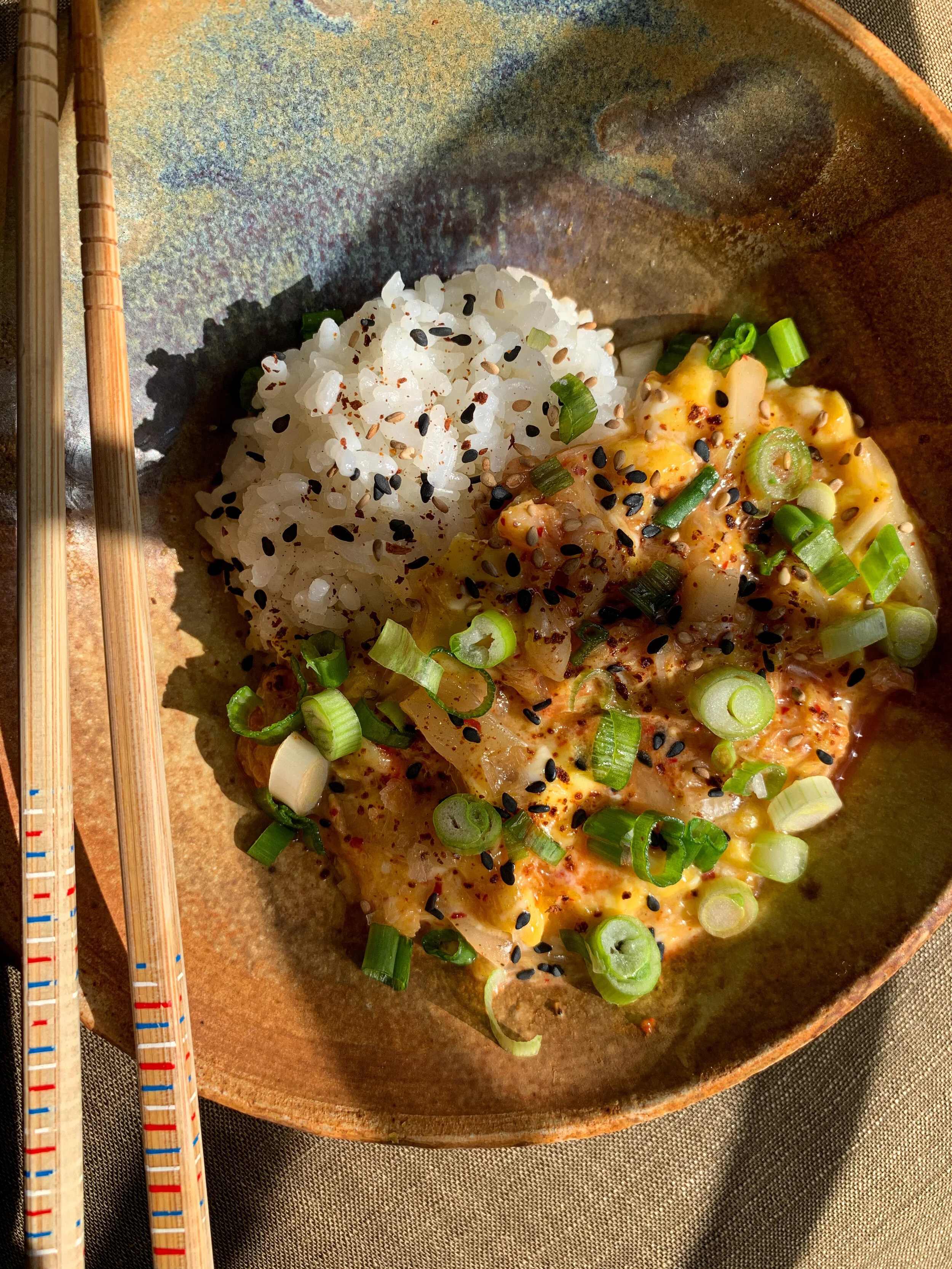
If you decide to test these eggs, please tag me @everythingalexcooks,
(and I mean actually tag me, the new IG update doesn’t notify me when I simply get mentioned in a caption).
I want to see your creations and hear your thoughts!
non-negotiables
- steel cut oats – using a combination of different grains enhances the texture of the oatmeal. Steel cut oats do not entirely cook through compared to the buckwheat.
- white miso – miso varies by salinity and fermentation time: white > yellow > red > brown. White miso subtly enhances sweet dishes, adding a butterscotch flavor.
try experimenting with
- frozen banana – I’ve noticed the banana flavor is intensified when I add a frozen instead of fresh banana to the mush.
- buckwheat – if buckwheat is hard to come by, then feel free to opt for your whole grain of choice or on hand. Toast the whole grains in the same fashion, but adjust cooking time.
extra ingredients?
- Extra miso? Cook the Tofu (see “miso brown butter x black pepper crispy tofu” on the blog).